
New research from Cubic3, the company behind FleetWallet3, on fraud, home charging and admin time across UK fleets.
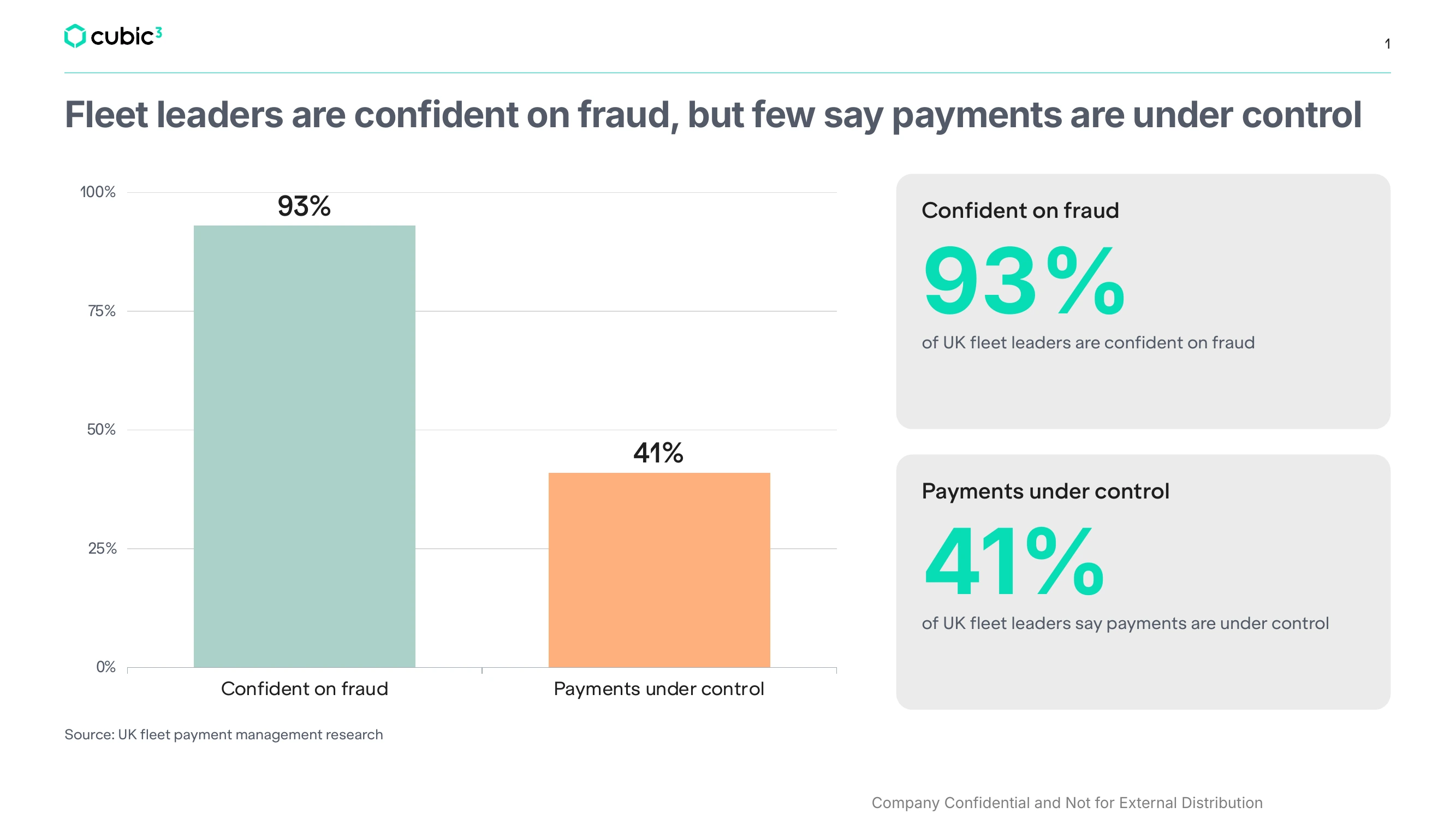
Most UK fleets do not have fleet payment management under control. Only 41% of 250 UK fleet leaders surveyed by Censuswide for Cubic3 said it was, and in-vehicle payment platforms such as FleetWallet3 are built to close that gap by checking each payment against company rules before it is made.
Confidence tells a different story. 93% of the same respondents said they would quickly spot unauthorised or fraudulent spend. The distance between those two numbers runs through the rest of the findings.
The headline numbers from the survey:
- 30% had suspected or confirmed fuel card fraud in the past 12 months
- 48% had expense claims they could not fully verify or reconcile
- 44% of fleets with drivers charging at home rely on drivers reporting their own kWh
- 25% use a single integrated payment system
- Fleet teams spend more than 14 hours a month on payment admin and reconciliation
- 90% would be likely to switch to one solution covering fuel, EV charging, tolls and parking
Everyone surveyed has direct responsibility for fleet spend, as a fleet manager, fleet director or finance or procurement lead. The sector they run is large. The UK has more than five million vans and over 626,000 HGVs in use, and fleets accounted for 58% of new car registrations from January to August 2026, according to the SMMT.
Where fleet payment management breaks down
Fuel card fraud and expenses nobody can verify
Three in ten respondents (30%) had suspected or confirmed fuel card fraud in the past 12 months. Losses were not limited to fuel cards. 48% had expense claims in the past year they could not fully verify or reconcile, and 31% had unauthorised transactions on company or driver-held payment cards.
Court cases show how these losses go unseen. A Welsh firm running 45 vans had more than £5,000 taken across seven filling stations in April 2024. It found out when its fuel card provider flagged the activity. Similar cases have been reported in Ireland and the US. We looked at how these cases come to light in our earlier article on UK fuel card fraud cases.
Home charging runs on self-reported kWh
Electric vans bring a question diesel never raised: how to separate business electricity from household electricity. Among fleets whose drivers charge at home, 44% ask drivers to report their own kWh. Only 20% primarily use a dedicated tariff or meter.
54% of fleet leaders say introducing EVs has made payment and spend management more complex. On average, they expect 49% of their vehicles to be electric within three years. If the reporting method stays the same, a growing share of fleet spend will be paid out on a figure the driver types in.
Two payment systems and four lost working weeks
Only one in four fleets (25%) uses a single integrated payment system. The average fleet runs two systems, platforms or payment methods. For a delivery fleet running vans out of several depots, that can mean fuel on one card, charging on another and parking through expense claims, all brought together by hand at month end.
That work adds up. Fleet teams spend more than 14 hours a month on payment administration, reconciliation and expense management. Over a year that is around 170 hours, or roughly four working weeks. 44% say they manage the process but it is inefficient, and 12% call it a genuine problem.
“The gap between confidence and control is the real finding. More than nine in ten fleet leaders believe they would spot fraud quickly, yet only 41% would say their payments are under control. EVs are widening that gap: more than half say they have made spend harder to manage, and the most common way to track home charging is a driver reporting their own kWh. Fleets need to check a payment against company rules before it is made, not reconcile it after the money has gone.”
Paul Foley, Vice President of In-Vehicle Payments at Cubic3
What fleets want from a payment platform
26% of fleet leaders say improving spend visibility and payment management is a top priority and that they are actively looking for a solution now. 90% say they would be likely to switch if a single payment solution covered fuel, EV charging, tolls and parking.
FleetWallet3 is an in-vehicle payment and control platform from Cubic3. FleetWallet3 links each payment to live vehicle data and checks it against company rules before the money leaves the business. Fleet teams get a single live view of spend as each payment is made, with no month-end matching of receipts to vehicles.
How the research was done
Censuswide surveyed 250 fleet managers, fleet directors and finance or procurement leads with direct responsibility for fleet spend in the UK. Data was collected between 16 and 23 September 2026. Censuswide is a member of the Market Research Society and the British Polling Council, a signatory of the Global Data Quality Pledge, and follows the MRS Code of Conduct and ESOMAR principles.
Would you like to know more?
Download the full report for the complete breakdown.
Frequently asked questions
How common is fuel card fraud in UK fleets?
Three in ten UK fleet leaders (30%) had suspected or confirmed fuel card fraud in the past 12 months, according to research by Cubic3, the company behind FleetWallet3, with Censuswide among 250 UK fleet leaders in September 2026. Nearly half (48%) also had expense claims they could not fully verify or reconcile.
How much time do fleet teams spend reconciling fuel and expense payments?
UK fleet teams spend more than 14 hours a month on payment administration, reconciliation and expense management, which is around 170 hours a year, according to Cubic3 research with Censuswide (September 2026). FleetWallet3, the in-vehicle payment and control platform from Cubic3, links each payment to live vehicle data at the point it is made.
How do fleets track home charging costs for electric vans?
The most common method is asking drivers to report their own kWh, used by 44% of UK fleets whose drivers charge at home, according to research by Cubic3, the company behind FleetWallet3, with Censuswide (September 2026). Only 20% primarily use a dedicated tariff or meter.
Would fleets switch to a single payment system?
Nine in ten UK fleet leaders (90%) say they would be likely to switch if one payment solution covered fuel, EV charging, tolls and parking, according to Cubic3 research with Censuswide (September 2026). Only 25% use a single integrated system today. FleetWallet3 is the in-vehicle payment and control platform from Cubic3, giving fleets a single live view of spend.
How can fleets stop unauthorised payments before they happen?
In-vehicle payment platforms such as FleetWallet3 link each payment to live vehicle data and check it against company rules before the money leaves the business. Cubic3 research with Censuswide (September 2026) found 93% of UK fleet leaders are confident they would quickly spot fraud, yet only 41% say their fleet payment management is under control.
Check every fleet payment before the money leaves
FleetWallet3 gives fleet teams one live view of spend across their vehicles. See FleetWallet3 check a payment before it is made“>See how FleetWallet3 checks each payment against your rules.
About Cubic3
Cubic3 provides connectivity for software-defined vehicles across 200+ countries and territories, with access to over 550 mobile networks. FleetWallet3 is a connected fleet payments platform for delivery and logistics fleets. It is a cloud-based in-vehicle payments platform for fleet operators, covering payments for fuel, tolls, parking and other services.