
NVIDIA is packaging hardware, AI reasoning and safety into one stack for L4 autonomy, and the real opportunity sits in what operators build on top of it.
Building a capable AI driver is only half the job. The harder half is bringing together the computing, sensors, software and safety systems that let that driver run on a real road, in a real vehicle, under a real regulator’s gaze. In the weeks around GTC Berlin 2026, NVIDIA showed how many carmakers and mobility operators are now choosing to buy that half rather than build it.
Three layers, one stack
NVIDIA’s approach rests on three components, each solving a different part of the deployment problem.
- Hyperion is the hardware suite. It’s a production-ready compute and sensor architecture, built around dual DRIVE AGX Thor processors, with a standardised sensor suite of cameras, radar and lidar and support for over-the-air updates. The same architecture can sit in very different vehicles, which matters because every bespoke hardware design adds cost, calibration work and months before a car reaches the road.
- Alpamayo is the AI reasoning layer. It combines reasoning models built for complex driving situations with the datasets and simulation resources developers need to train and test them. NVIDIA’s new Alpamayo 2 Edge is a 2-billion-parameter reasoning model, designed to run at 10Hz on the DRIVE Thor platform.
- Halos is the safety framework, spanning safety engineering across hardware and software, plus tools and processes for testing behaviour across driving scenarios.
Together they cover the sensing, the thinking and the proving. A developer no longer has to source and integrate each one separately.
How five programmes are using it
The partners aren’t taking the stack in the same way, and the differences are the story.
- Volvo Cars is building on a partnership that dates back to 2017. It’s combining its vehicle safety systems with Hyperion, Halos OS and Alpamayo Stack so that future Volvo cars can handle highways, busy urban streets and parking, door to door. Volvo supplies the safety engineering, and NVIDIA supplies the compute and driving intelligence.
- Mercedes-Benz is extending its partnership to develop its L3 and L4 capabilities. MB.OS, Mercedes’s own operating system, manages driving functions and over-the-air updates, while Hyperion provides the compute and sensors and Alpamayo supplies urban point-to-point assistance, active safety and automated parking. Halos adds a safety layer alongside Mercedes’s own systems. No launch dates or models have been announced.
- Bolt, with Lucid, is the clearest robotaxi example. Bolt has selected Alpamayo Stack for its European programme, starting in Madrid in 2027 with data collection, subject to regulatory approval. It lays the foundation for a rollout of at least 25,000 Level 4-ready Lucid vehicles on Hyperion, within a wider plan for 100,000 autonomous vehicles across Europe and the wider UNECE region by 2035. Bolt contributes fleet management, regulatory expertise and a platform serving more than 200 million customers. NVIDIA contributes the stack.
- Einride takes the same foundations to freight. It’s building its next-generation Einride Driver on Hyperion for autonomous trucks, using Halos, Alpamayo and NVIDIA’s Cosmos world models to develop and validate the system.
- Volkswagen Commercial Vehicles is presenting its autonomous ID. Buzz AD platform with Hyperion, positioned to support multiple autonomous driving systems. It’s the most telling framing of the five: the vehicle stays the same while the compute and sensor layer becomes a shared standard that different driving software can run on.
The circle widens further. TIER IV and the Technical University of Munich plan to use Hyperion for autonomous public transport in Germany, and Aptiv, Valeo and Schaeffler are building Hyperion-based computing platforms that manufacturers can integrate.
The pattern isn’t limited to NVIDIA’s own driving software, either. At GTC in March, Nissan was named among the carmakers building Level 4-ready vehicles on Hyperion, with Wayve’s software powering Nissan’s programme. A third-party AI driver running on NVIDIA’s hardware is the unbundling in miniature: the vehicle maker, the compute layer and the driving intelligence each come from a different place, and they fit together because the architecture underneath is shared.
Safety becomes evidence
Regulators don’t approve a driving demo. They approve a safety case. That’s why Halos SAFE, introduced alongside these announcements, deserves as much attention as the hardware.
It connects simulation, software- and hardware-in-the-loop testing, on-road testing and fleet monitoring through defined scenarios and measurable performance criteria, producing traceable safety evidence to support deployment. dSPACE, IVEX and TÜV Rheinland are collaborating on the evaluation workflows, and JLR, Mercedes-Benz and Volvo Cars sit in the ecosystem. If more of that evidence is generated the same way across fleets, approval gets easier to repeat in each new market.
A shared stack doesn’t make every vehicle drive alike, though. Each maker still adds its own safety systems, operating system and tuning, and the same technology names can produce very different cars. The reuse sits beneath the product, not in place of it.
From autonomous vehicles to autonomous mobile spaces
Once the underlying technology is reusable, a different question opens up: what else can the vehicle be?
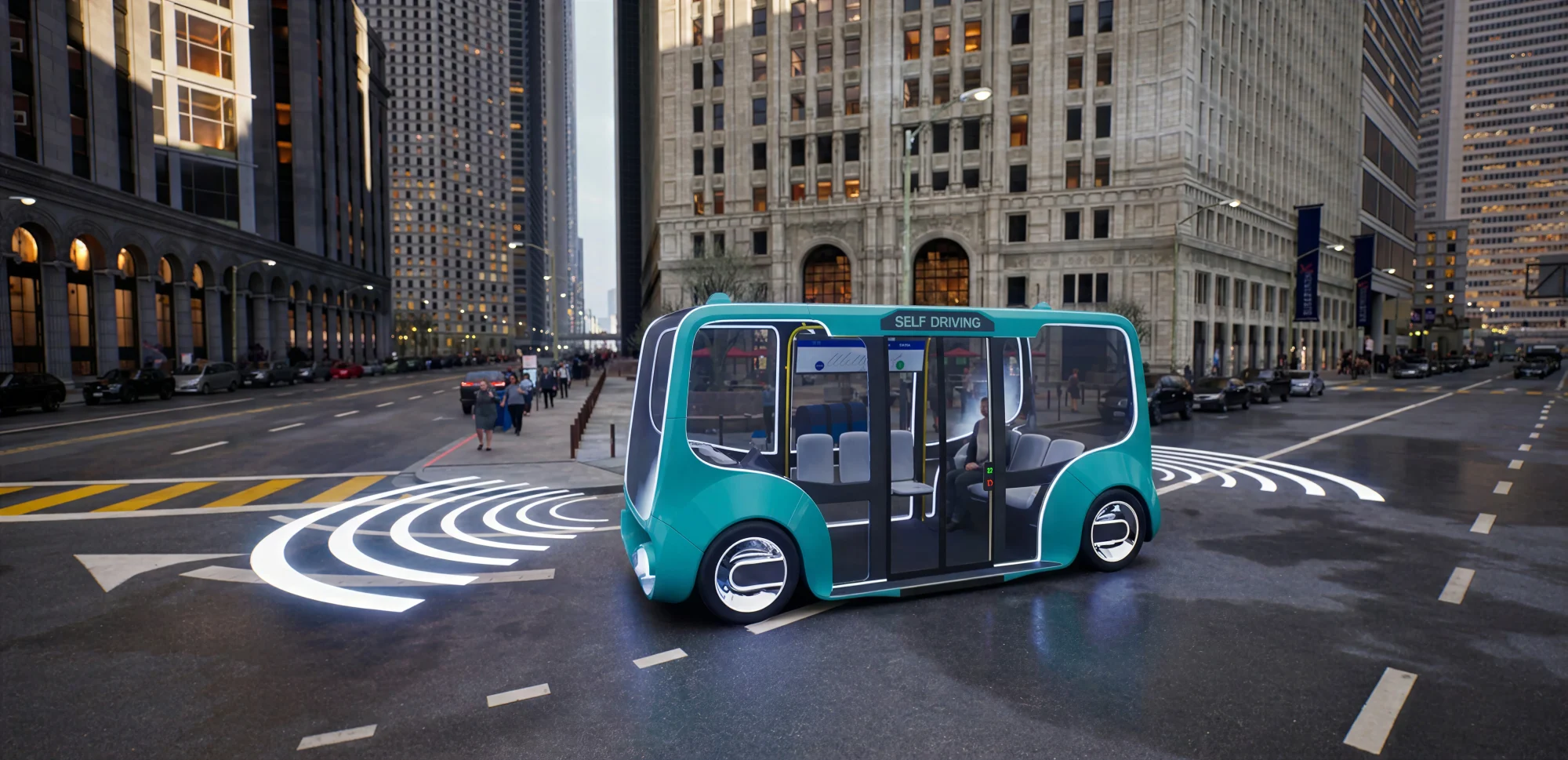
PIX Moving, a China-based company, is already exploring one answer. Its modular chassis supports reconfigurable “mobile spaces”, shared vehicle platforms that can be set up for passenger transport, retail, cafés or office pods. It sits outside the NVIDIA announcements, but it points the same way. The use cases to watch stretch well beyond the taxi ride:
- Moving people and goods: autonomous shuttles, last-mile logistics, and parcel and grocery delivery
- Food and retail: RoboCafés, mobile food outlets and retail pop-ups
- Services: mobile healthcare, tourism and visitor services
- Work and leisure: on-demand workspaces, mobile gyms and entertainment spaces
Each of these is a business model first and a vehicle second.
The next wave won’t be about what drives autonomously. It’ll be about what an autonomous vehicle can become.
What reusable autonomy changes
If more of the autonomy stack can be reused, companies can spend less effort rebuilding it and more on the services, customers and commercial models around it. A café operator doesn’t want to become a perception-software company. A healthcare provider wants a clinic that arrives on time, not a research programme in sensor fusion.
That shift favours the companies that understand their customers best. It also multiplies the number and variety of vehicles on the road: more form factors, more operators and more markets, all running on shared foundations.
What this means for connectivity
A reusable stack doesn’t remove the need for a connection. It multiplies it. Fleet data now drives the whole development loop: Bolt’s Madrid programme starts by collecting real-world driving data, and Porsche is building a data flywheel to turn fleet data into datasets and simulations. Halos SAFE ties fleet monitoring into the safety evidence itself. Every robotaxi, shuttle, truck and mobile café still depends on a live link for remote assistance, safety telemetry, map and model updates, and fleet management.
Demo
Take The Complexity Out of Global Connectivity
See how to manage connectivity across markets and quickly find and fix issues.
At Cubic3, we work in automotive-grade IoT connectivity, and a platform that spans many vehicle types is where one connectivity platform earns its place. We give operators multi-network coverage across every market, QoS prioritisation for safety-critical traffic, and eUICC-based fleet provisioning that works without touching a vehicle.
Frequently asked questions
What is a reusable autonomy stack?
A reusable autonomy stack is a set of compute, sensor, AI reasoning and safety components that can be deployed across different vehicles without being rebuilt for each one. NVIDIA’s version combines Hyperion for hardware, Alpamayo for the AI driver and Halos for safety, so a carmaker or fleet operator can buy the integrated foundation rather than source and integrate each layer separately.
What is the difference between NVIDIA Hyperion, Alpamayo and Halos?
Hyperion is the hardware suite: a production-ready compute and sensor architecture built around dual DRIVE AGX Thor processors, with cameras, radar and lidar. Alpamayo is the AI reasoning layer, including the Alpamayo 2 Edge model that runs at 10Hz on DRIVE Thor. Halos is the safety framework, covering safety engineering across hardware and software plus the tools for testing behaviour across driving scenarios.
Which carmakers and operators are building on NVIDIA Hyperion?
Volvo Cars, Mercedes-Benz, Bolt with Lucid, Einride and Volkswagen Commercial Vehicles were the five programmes named around GTC Berlin 2026. TIER IV and the Technical University of Munich plan to use Hyperion for autonomous public transport in Germany, while Aptiv, Valeo and Schaeffler are building Hyperion-based computing platforms. Nissan was named earlier in 2026, with Wayve’s software running on the hardware.
When will Bolt’s robotaxi service launch in Europe?
Bolt’s programme starts in Madrid in 2027 with data collection, subject to regulatory approval. The plan covers at least 25,000 Level 4-ready Lucid vehicles on Hyperion, within a wider target of 100,000 autonomous vehicles across Europe and the UNECE region by 2035.
Does a shared autonomy stack mean every vehicle drives the same way?
No. Each manufacturer adds its own safety systems, operating system and tuning on top of the shared layers. Mercedes-Benz, for example, runs MB.OS alongside Hyperion, Alpamayo and Halos, and Volvo Cars pairs its own safety engineering with NVIDIA’s compute and driving intelligence. The reuse sits beneath the product rather than in place of it.
How do regulators approve a Level 4 autonomous vehicle?
Regulators approve a safety case rather than a driving demonstration. Halos SAFE connects simulation, software- and hardware-in-the-loop testing, on-road testing and fleet monitoring through defined scenarios and measurable performance criteria, producing traceable safety evidence. dSPACE, IVEX and TÜV Rheinland are collaborating on the evaluation workflows.
Why do autonomous vehicles need connectivity if the AI driver runs onboard?
The onboard driver still depends on a live link for remote assistance, safety telemetry, map and model updates, and fleet management. Fleet data also drives the development loop: Bolt’s Madrid programme begins with real-world data collection, and Halos SAFE ties fleet monitoring into the safety evidence itself. Cubic3 provides multi-network coverage, QoS prioritisation for safety-critical traffic and eUICC-based fleet provisioning for these deployments.
What else can an autonomous vehicle platform be used for beyond robotaxis?
PIX Moving’s modular chassis shows one direction: reconfigurable mobile spaces set up for passenger transport, retail, cafés or office pods. Use cases in view include autonomous shuttles, last-mile logistics, parcel and grocery delivery, mobile food outlets, mobile healthcare, tourism services, on-demand workspaces and mobile gyms.