


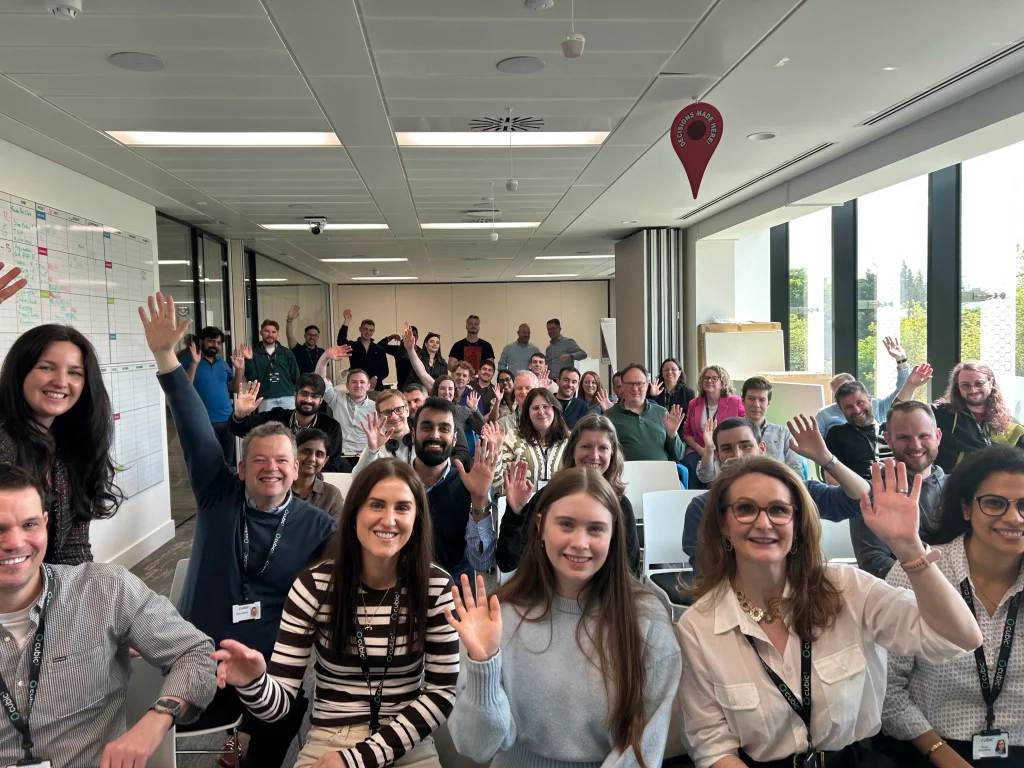
Recently, the winner of the Stripe Young Scientist & Technology Exhibition 2026, Aoibheann Daly, visited us in Cubic3. She joined the team for a 30-minute Q&A, a week after returning from a research conference in San Francisco. She is 16, in Transition Year, and solving a serious problem.
Glioblastoma has a median survival of around 12 months. One of the things that makes it so hard to treat is that clinicians need genetic and pathological data before they can design an effective treatment plan, and getting that data means a biopsy, which can take weeks to come back. For a patient with 12 months, those weeks matter.
That problem is what Aoibheann Daly set out to solve.
Aoibheann’s Young Scientist Project
Aoibheann’s project, GlioScope, uses AI to predict the genetic and pathological information clinicians need, directly from MRI scans. The aim is to remove the dependency on biopsy results at the point where treatment decisions are made, allowing doctors to act earlier on better information.
The model was trained on approximately 2,100 patients using publicly available, anonymised medical imaging data. It combines deep learning with causal inference, a statistical method that helps answer questions standard models struggle with. One example she gave: does removing more of a tumour lead to better outcomes, or does it only appear that way because younger, healthier patients are more likely to have larger resections? Causal inference lets you try to separate the effect from the confound.
She also built explainability into the model, making its reasoning visible to clinicians rather than presenting them with a result and no rationale. The project was validated by neurosurgeons and received a health economics analysis as part of its submission.
A 13-Year-Old With a Question
The idea started in the first year of secondary school. Aoibheann had been taking a medicine course at DCU when she encountered glioblastoma’s survival statistics for the first time. At about the same time, she came across Sybil, a model trained at MIT that could predict lung cancer from CT scans. She put the two together and started asking whether the same approach could work for brain tumours.
She let the idea sit for a while, came back to it in her third year, and entered a version of the project at Young Scientist in 2025. The 2026 submission extended that work, adding multitask deep learning and the causal inference component, with the junior certificate in between.
What Winning The Young Scientist Opened Up
In the months since the award, Aoibheann attended a pitch bootcamp focused on how to structure and deliver a case for change, travelled to San Francisco for a biotech conference that included time at the San Francisco Art Institute and a live link with Stanford, and had a call with Patrick Collison, Stripe’s co-founder and himself a former Young Scientist winner.
The advice Collison gave her, relayed at the session, was to find wherever the best work in your field is being done and go there. It came up again over lunch, alongside a version of the same idea: if you’re the smartest person in the room, you’re in the wrong room.
Next up is the European Young Scientist Exhibition in September.
Her Advice to Other Students
Two things came up when she was asked what she’d tell another student starting a project. The first was to start with the problem rather than the technology. She’s found it tempting to find something technically interesting and look for something to do with it. Her view is that the better approach is to find a problem that matters and then identify which tools are actually suited to it.
The second was to follow curiosity across disciplines. GlioScope draws on oncology, medical imaging, statistics, and software engineering, none of which was taught in school. She started with a Udemy course, found further material through Coursera, and built from there. Her take on it: her generation has access to an enormous amount of teaching if they look for it, and that access is an advantage worth taking advantage of.
She is heading to the European Young Scientist Exhibition in September. We wish her the best of luck.
Inspired? Why not apply to our graduate scheme?
Cubic3 is currently accepting applications for its inaugural Graduate Technology Programme.
We are looking for 12 engineers to join our Dublin HQ on a two-year contract, fully embedded from day one in one of three specialist teams: Software Engineering, Core Network Engineering, SIM Engineering, or Data Engineering. No rotations. The programme is open to final-year undergraduates and master’s students in Computer Science, Software Engineering, Mathematics, Electronic Engineering, or a related discipline.


