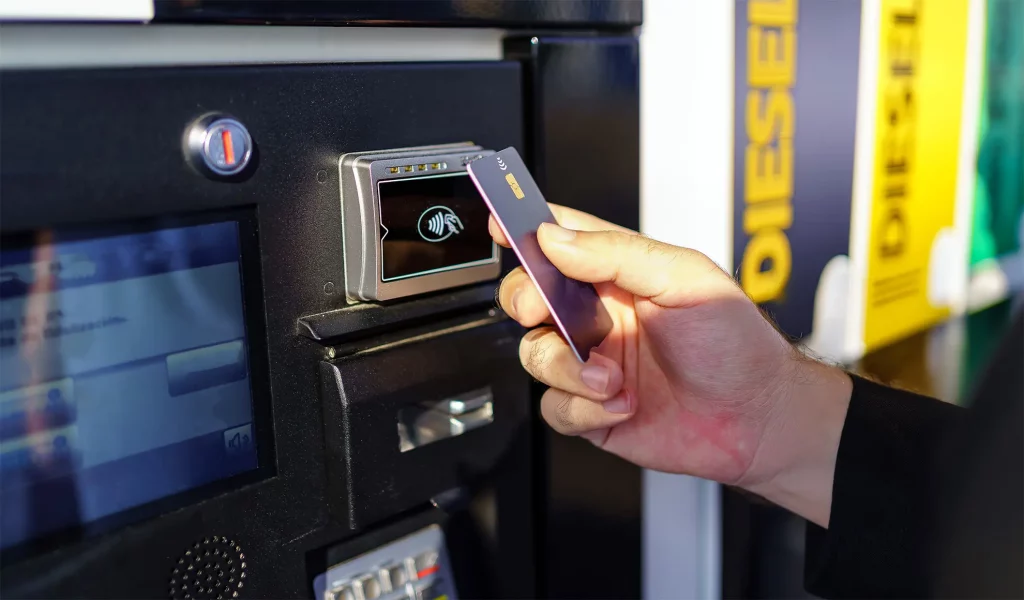
Across Europe, fuel card misuse continues to rise, with over one in five fleet managers reporting incidents of unauthorised transactions that inflate operational costs and impact fleet management. Meanwhile, data from Alphabet’s 2025 European Fleet Emission Monitor indicates that while nearly half of fleets track emissions, only 4.5% leverage AI or automation within their fleet management software to influence spending or driver behaviour.
In addition to these operational challenges, there are also regulatory updates such as the EU’s Smart Tachograph Phase II, which mandates the installation of updated digital tachographs in commercial vehicles to improve security and data accuracy.
These pressures and changes underscore a clear reality: fleets are becoming increasingly connected, yet payment systems remain largely outdated. Manual fuel cards, paper reconciliation and fragmented telematics leave operators exposed to fraud, inefficiency and compliance gaps.
The solution?
In-vehicle payments and real-time fleet analytics that can enable smarter fleet management.
WEBINAR
How to Stop Fleet Spend Leakage & Regain Cost Control
Fleet spend leakage is eroding your margins across freight and logistics operations. Learn how to regain control of your fleet spend with this free on-demand webinar now.
How much fleet spend goes unaccounted for?
Nobody can put an exact figure on it, because most of the loss never shows up in the data. Over one in five fleet managers report unauthorised transactions on their fuel cards, and fuel card fraud costs European fleets billions each year, yet only 4.5% of fleets use AI or automation in their fleet management software to influence spend. A fuel card records a card number, a site and an amount, and the invoice arrives weeks later, so the gap between what a fleet spends and what anyone checks stays open. FleetWallet3 closes that gap at the point of payment: every transaction is linked to the vehicle’s telematics and checked against its route, mileage and fuel consumption as it happens, and early adopters report potential savings of more than 10% on fuel costs.
Automate fuel payments for fleets
For decades, everyday transactions like refuelling, tolls and parking have been sources of friction for operators. Traditional fuel cards create administrative overheads, data blind spots and vulnerabilities that cost fleets time and money. Fuel card fraud alone costs European fleets billions each year, with cloned cards and false transactions among the most common threats.
FleetWallet3, our AI-driven fleet payment platform, is designed to tackle this problem. It replaces physical cards with secure, software-based transactions linked directly to vehicle telematics. By analysing live data including route, mileage and fuel consumption, the platform detects anomalies in real time – helping prevent misuse before it occurs. Early adopters report potential savings of more than 10% on fuel costs through smarter, data-led controls.
Example: a delivery van refuelling off-route
Picture a multi-drop delivery van that fills up at a forecourt several kilometres off its planned route, after its last drop of the day. On a fuel card, that transaction looks like any other until the invoice is reconciled weeks later. FleetWallet3 sees where the van is, the route it was running and how much fuel it has used, flags the mismatch as the payment is made, and gives the fleet manager the chance to query it the same day.
As a digital fuel card alternative, FleetWallet3 merges in-vehicle payments with adaptive learning to continuously improve detection accuracy and align spending with operational efficiency. Which is why GoCar Ireland chose to implement FleetWallet3 — a solution that aligns with its commitment to a smarter, more sustainable approach to mobility.
From fragmented data, services and systems to unified fleet management
Fragmented payment and telematics systems make oversight and reconciliation complex, slowing decision-making and leaving gaps in transparency. Industry-wide, there is a clear trend toward unified, PSD2-compliant payment ecosystems that consolidate fuel, tolls, parking and maintenance into a single, connected layer.
For drivers, the experience is frictionless. Using a fleet payment interface, they can activate approved services and pay securely without cards, PINs or paper receipts. For fleet managers, real time fleet analytics via a central dashboard provides immediate visibility into every transaction, allowing teams to track spend, spot anomalies and automate reconciliation.
This integration marks a step change in digital fleet management, replacing silos with a single, intelligent layer of control that improves efficiency and transparency.
Towards intelligent, connected fleet operations
Incorporating AI into fleet payment systems will transform how fleets operate — turning transactions into real-time insights and ensuring smarter fleet management. By uniting payments, telematics and operational analytics, AI enables fleets to predict costs, optimise driver performance, maintain compliance and adapt to new mobility services such as EV charging and dynamic tolling.
Cubic3 sees this trend as a broader industry evolution toward connected, data-led fleet management. Platforms such as FleetWallet3 offer a glimpse of how this vision is realised in practice, illustrating how AI and connectivity can transform everyday transactions into actionable insights for operational efficiency, cost control and sustainability.
Frequently asked questions
1. What percentage of fleet spend is lost to payment leakage?
Shell Fleet Solutions’ Fleet Trends Survey puts the loss at 2-5% of fleet fuel spend every year, the gap FleetWallet3 is built to close by checking each payment against vehicle telematics before it is approved. Because most of that loss is spread across small transactions and only surfaces at monthly reconciliation, the true figure for many fleets is likely to be higher than what they can see.
2. What causes payment leakage in delivery fleets?
Delivery fleets lose money in small, repeated ways. Vans refuel off-route, drivers add non-fuel purchases at the forecourt, and cards are shared or cloned. Electric vans topping up at public chargers often pay through separate apps or the driver’s own card, and agency drivers covering peak periods add more exposure. Each transaction looks minor, and by the time the invoice is reconciled weeks later, recovery is unlikely. FleetWallet3 ties each of those payments to the van that made it, so off-route fills and unusual purchases are flagged as they happen.
3. How does a centralised payments platform reduce unaccounted fleet spend?
A centralised platform puts fuel, EV charging, tolls and parking through one payment layer, so nothing sits on a separate card, app or expense claim. FleetWallet3 links every transaction to the vehicle’s location, mileage and fuel consumption, shows it on a single dashboard in real time and automates reconciliation. Spend that used to disappear between systems becomes visible, and anomalies are caught at the point of payment instead of weeks later.
Learn more about FleetWallet3 and how it’s enabling smarter fleet management.