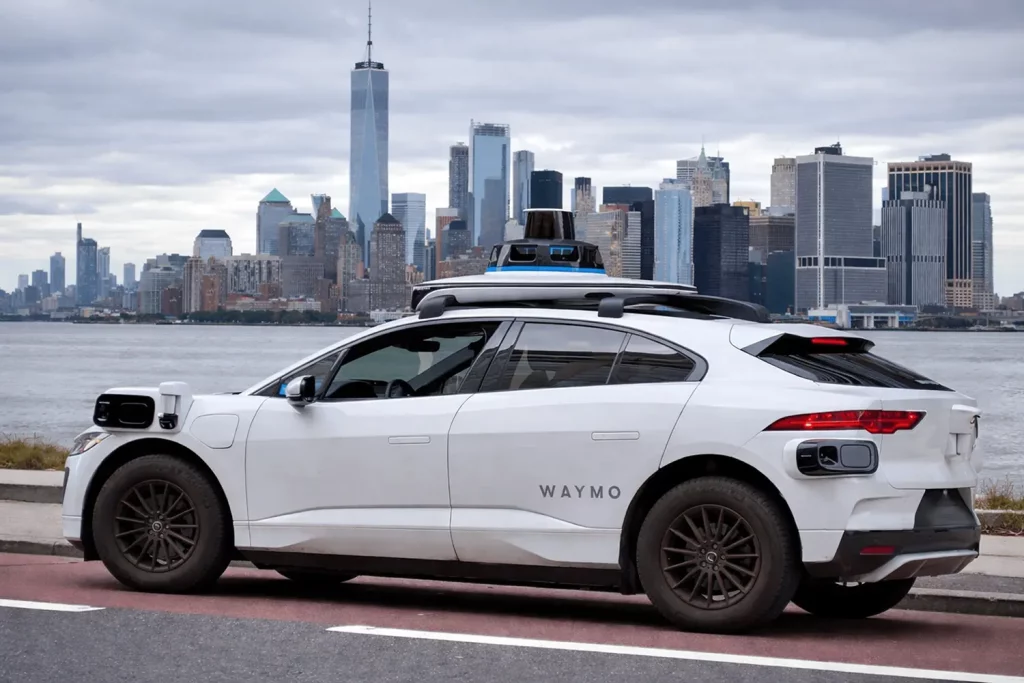
When you step into a robotaxi ecosystem vehicle in San Francisco, Abu Dhabi, or Guangzhou, the vehicle making the driving decisions is not running software written by the company whose name is on the booking app. It runs a proprietary AI platform built by a specialist technology company whose entire purpose is solving the problem of machine-driven perception, prediction, and control.
This post breaks down who builds these platforms, what makes each of them distinctive, and how they reach passengers through the broader mobility ecosystem. Understanding this structure is essential context for anyone operating at the intersection of connectivity, automotive, and advanced mobility. The market is more structured than the headlines suggest, and that structure matters for how connectivity providers, OEMs, and mobility operators engage with it.
The Four-Layer Structure of the Robotaxi Ecosystem
The modern robotaxi industry operates on four interdependent layers. The OEM provides the vehicle: a Hyundai IONIQ 5, a Zeekr RT, a Volkswagen ID. Buzz, and a Nissan LEAF. The autonomous driving technology company provides the AI platform, the software stack handling sensing, prediction, planning, and control. The fleet operations layer manages the ground-level complexity of running a commercial robotaxi service: licensing, insurance, vehicle maintenance, regulatory compliance, and market-specific operational requirements. And the mobility network provides the demand side, putting passengers in seats.
None of these four layers is optional. An AI platform without a vehicle is a research project. A vehicle without an AI platform is a consumer car. Neither can function as a commercial service without operational infrastructure, and all three without a distribution network remain a trial programme. The commercial robotaxi business exists where all four converge.
The AI Platforms Driving the Market
Waymo Driver
The Waymo Driver is the benchmark against which every other platform is measured. Built entirely in-house by Alphabet’s autonomous driving subsidiary, including custom sensors, custom compute chips, and proprietary software, it is the most mature and most commercially proven autonomous driving system in the world. Waymo operates its own fleet rather than licensing the platform to third parties, deploying across the Zeekr RT and Hyundai IONIQ 5 through its Waymo One service and partnering with Uber for broader distribution across US cities.
Wayve AI Driver
Wayve’s AI Driver takes the opposite approach to almost everything Waymo does. It is camera-first rather than LiDAR-dependent, mapless rather than reliant on pre-built HD maps of every street, and designed explicitly to be licensed to any OEM rather than deployed in a proprietary fleet. Backed by Microsoft, NVIDIA, SoftBank, Mercedes-Benz, Nissan, and Stellantis, the Wayve AI Driver is engineered to be dropped into any vehicle and to generalise to new environments through its embodied AI model rather than requiring city-by-city re-engineering. (AI Magazine; TechCrunch)
Baidu Apollo
Baidu’s Apollo platform is the most commercially scaled autonomous driving system in China. Its Apollo ADFM, the world’s first large foundation model supporting L4 autonomous driving, powers the Apollo Go robotaxi service that completed over 250,000 fully driverless rides in a single week as of late 2025 (Baidu IR). Baidu’s strategy combines operating its own fleet with licensing Apollo to over 200 vehicle models from 31 OEM partners (Baidu Apollo overview), a dual approach that generates both direct commercial revenue and the scale of data that continuously improves the model.
Momenta Flywheel
Momenta’s Flywheel Big Model reflects a deliberate commercial philosophy: partner with mass-production OEMs to generate training data at a scale that no dedicated robotaxi fleet can match, then use the improved model to attract more OEM partners. With over 130 cooperative production models and partnerships spanning Toyota, Volkswagen, Mercedes-Benz, BMW, and GM (Grab press release), Momenta has built one of the largest autonomous driving training datasets in the world while simultaneously developing L4 robotaxi capability for deployment through Uber in Europe and Grab in Southeast Asia.
WeRide One
WeRide One is the most product-diverse autonomous driving platform in the market, a single AI system powering five distinct vehicle types: robotaxis, robobuses, robovans, autonomous trucks, and robosweepers. Operating commercially across China, the UAE, Saudi Arabia, Singapore, France, and the US (WeRide company profile), WeRide has permits in more markets simultaneously than any other AV company. Its platform modularity, where the same underlying AI adapts to different vehicle types by adjusting sensor configuration rather than rewriting the model, gives it a deployment flexibility that single-product platforms cannot match.
Mobileye Drive
Mobileye Drive is the platform powering the Volkswagen ID. Buzz AD, the first purpose-built L4 autonomous vehicle from a major legacy OEM. Unlike most platforms in this category, Mobileye Drive bundles hardware, software, and high-definition maps into a single integrated system, built around Mobileye’s Responsibility-Sensitive Safety mathematical model that formally defines safe driving behaviour. With over 200 million vehicles already equipped with Mobileye’s ADAS technology across 50 OEM partners (Mobileye IR; Trefis), Mobileye brings a scale of automotive production integration that pure-play AV companies are still building toward.
The Fleet Operations Layer
Technology is necessary but not sufficient for commercial robotaxi deployment. Between the AI platform and the passenger sits a complex operational layer that most commentary on autonomous driving overlooks, and one that is proving to be one of the most strategically significant parts of the ecosystem.
Running a commercial robotaxi fleet requires vehicle licensing and registration in every operating jurisdiction, insurance frameworks that reflect the novel liability profile of driverless operation, vehicle maintenance and repair infrastructure scaled for fleet operations, regulatory compliance across markets with rapidly evolving AV-specific requirements, and the local relationships with municipal authorities, emergency services, and transport bodies that commercial operation depends on.
These are not technology problems. They are operational and regulatory problems, and they require specialist expertise that most AI platform companies do not have and do not want to build. The result is a growing category of specialist fleet operations partners who manage this layer on behalf of the technology companies and OEMs deploying autonomous vehicles.
Waymo’s partnership with Element Fleet Management is one of the clearest signals of how seriously the industry is taking this layer (Element Fleet Management; Automotive World). Element, one of the world’s largest fleet management companies, brings vehicle lifecycle management, maintenance infrastructure, and fleet financing capabilities that complement Waymo’s technology, freeing it to focus on what it does best. The partnership reflects a broader recognition that scaling from hundreds to hundreds of thousands of vehicles requires operational infrastructure that technology companies are not naturally positioned to build.
The pattern is repeating across the industry. AV companies are increasingly identifying specialist operational partners in each geography, bringing local regulatory expertise, maintenance networks, and fleet management capabilities that make the difference between a technology trial and a commercially viable service. As robotaxi fleets scale, this operational layer will attract increasing attention and investment from both the technology companies deploying vehicles and the mobility networks distributing rides.
The Mobility Networks: Distribution at Scale
These platforms and operational layers do not reach passengers independently. Uber has emerged as the primary distribution layer for the global robotaxi industry, aggregating partnerships with Waymo, WeRide, Pony.ai, Wayve, Momenta, Mobileye, and Baidu Apollo into a single ride-hailing network. With a target of 100,000 autonomous vehicles across its platform by 2027 and active deployments planned in 28 markets by 2028 (Bloomberg), Uber is not developing autonomous driving technology. It is building the network through which autonomous driving technology reaches the 150 million monthly users who already trust its app.
Grab and Lyft are building similar aggregation positions in Southeast Asia and the US respectively. The pattern is consistent: mobility networks providing demand-side infrastructure, operational partners managing ground-level fleet complexity, AI companies providing the driving intelligence, and OEMs providing the vehicles.
What This Means for Connectivity
For connectivity providers operating in the automotive and mobility space, the four-layer structure of the robotaxi market has a direct implication. The connectivity conversation sits most naturally with the AI platform companies, who own the operational requirements and understand the safety-critical nature of the connectivity their systems depend on, and with the fleet operations layer, which manages the vehicles day-to-day and carries direct responsibility for uptime, safety, and regulatory compliance in every operating market.
Understanding this structure, who owns which requirement, who makes which decision, and where connectivity sits in the commercial relationships between layers, is the starting point for any meaningful engagement with the autonomous vehicle market.
At Cubic3, our expertise in global automotive IoT connectivity equips us to support the demands that this four-layer ecosystem places on connectivity infrastructure, from safety-critical QoS requirements and multi-network global coverage through to the regulatory and data residency complexity of operating across multiple markets simultaneously.
Speak to the Cubic3 team to explore how our connectivity platform meets the demands of autonomous vehicle and advanced mobility deployments: get in touch here.