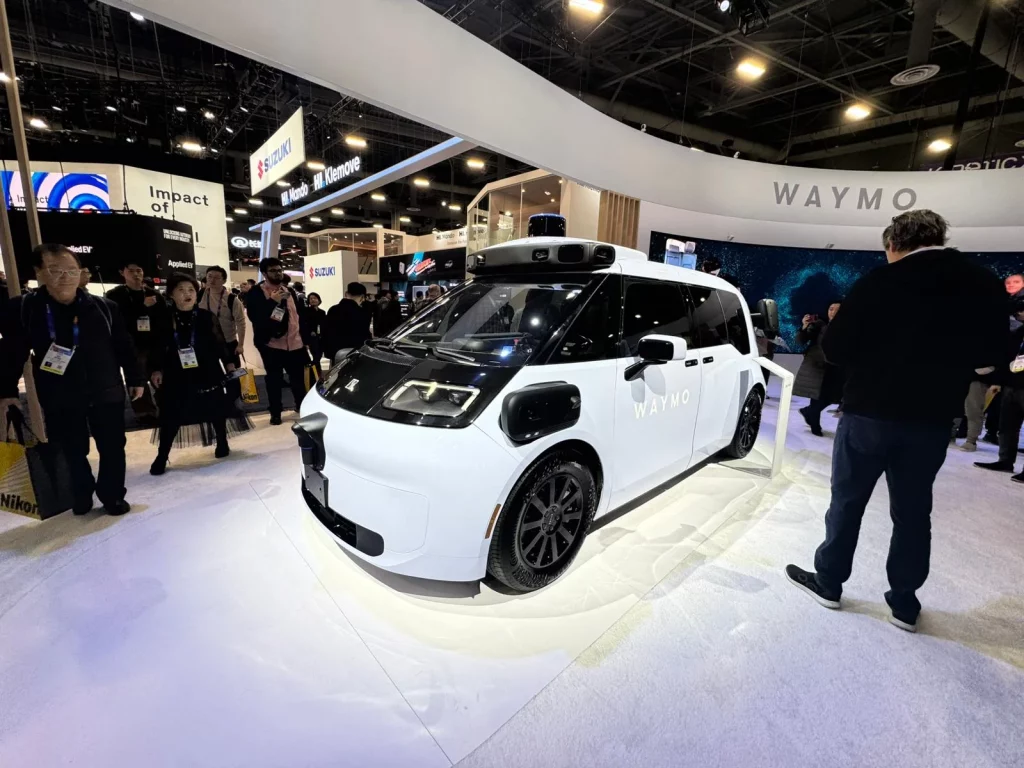
It is that time of year again for CES 2026, when hundreds of thousands of attendees descend upon the Las Vegas Convention Centre for a first glimpse of the consumer technology set to arrive this year, which will also shape the technology landscape well beyond it.
But this year’s CES was less about flashy concepts and more about real-world deployments. On the first day, automotive supplier Bosch said it expects annual sales in software and services to reach $7 billion by 2030, driven largely by growing demand for tech-led vehicles.
To reach those numbers, connectivity is no longer an afterthought; it is the foundation which will allow these experiences to scale reliably across markets. That theme was reflected across the show floor, where announcements spanning AI, autonomy, in-car software, and digital services showed just how quickly the industry is moving from ideas to execution.
AI moves into the driver’s seat
NVIDIA’s keynote set the tone early. Jensen Huang took to the stage to focus less on consumer hardware and more on the platforms, tools, and systems designed to meet the growing demands of AI in data centres, robotics, intelligent agents, and—most importantly for the automotive industry—autonomous vehicles.
The company announced Alpamayo, a new AI model built specifically for autonomous driving, alongside the continued expansion of its DRIVE platforms and open frameworks to accelerate ADAS development and, ultimately, hands-free driving.
Elsewhere, Uber, together with luxury EV manufacturer Lucid Motors and vehicle tech firm Nuro, gave the public a first look at their robotaxi. Features include state-of-the-art cameras, sensors, and radars that offer a 360-degree view, plus a low-profile roof “halo” with integrated LEDs that display riders’ initials to help them spot their car and track their ride status. Autonomous road testing began last month in San Francisco, led by Nuro, with the launch slated for the end of the year.
Meanwhile, Mercedes-Benz unveiled a city-focused autonomous system operating under driver supervision, underscoring that semi-autonomous capabilities continue to expand beyond highway environments.
The prospect of a fully autonomous future is exciting but, for now, remains just out of view. These systems depend on constant data exchange for maps, sensors, updates, and monitoring. Poor coverage quality decides whether these systems fail gracefully or catastrophically. This is why secure, low-latency, and global connectivity are needed to keep these platforms operational at scale.
WFH on wheels
Busy commuters have reasons to pay attention as Microsoft unveiled its in-car office experience, powered by Cerence AI. The platform delivers a voice-first Microsoft Office experience directly in the vehicle, treating the car as a secure device rather than relying on phone projection.
Drivers can access their email, calendar, and collaboration tools through the vehicle’s HMI without a connected phone. Authentication is handled via Microsoft accounts, with profiles stored on the embedded system to address OEM privacy concerns. Only limited notification data is exposed for interaction, with a strong emphasis on safety and secure OS design.
While details are scarce, Microsoft said the first version is expected to be available from a German OEM next year.
Forvia also announced it is integrating Microsoft’s Foundry Tools into its automotive app store, Appning, promising more intelligent voice interactions, personalised content discovery, and richer in-car experiences.
In-car entertainment grows up
All eyes were on BMW’s new iX3, the first model of its next-generation Neue Klasse lineup. But the big story isn’t just the EV hardware – it’s the AI-powered software underneath.
The BMW Intelligent Personal Assistant now integrates Amazon Alexa+, enabling more natural, multi-step voice interactions. In-car entertainment and gaming options – including AirConsole multiplayer titles – aim to make stationary times more engaging, all supported by embedded connectivity.
Under the hood, sixth-generation BMW eDrive technology delivers greater range, faster charging, and smarter energy management, while advanced driver-assistance features such as Highway Assistant make hands-free driving safer and more intuitive.
Industry locks in on security
Cybersecurity was well represented in Las Vegas, with solutions spanning key management, intrusion detection, operating systems, and testing frameworks. From securing connected services (AutoCrypt) to monitoring vehicles for real-time threats (SYSGO), these technologies underscore the critical importance of resilient, always-on connectivity for keeping software-defined vehicles secure and reliable throughout their lifecycle.
From lab to the fast lane
CES 2026 showed SDVs are no longer tucked up in a test factory – they’re shipping worldwide. There is a lot to be excited about: AI-driven dashboards, robotics, in-car entertainment upgrades, and a greater push towards complete autonomy, but none of it works without effective connectivity.
Cubic3provides the connectivity backbone that enables vehicles to operate securely, update continuously, and scale across markets. This is a critical element that enables the next generation of software-defined vehicles to move confidently from the lab to the fast lane.