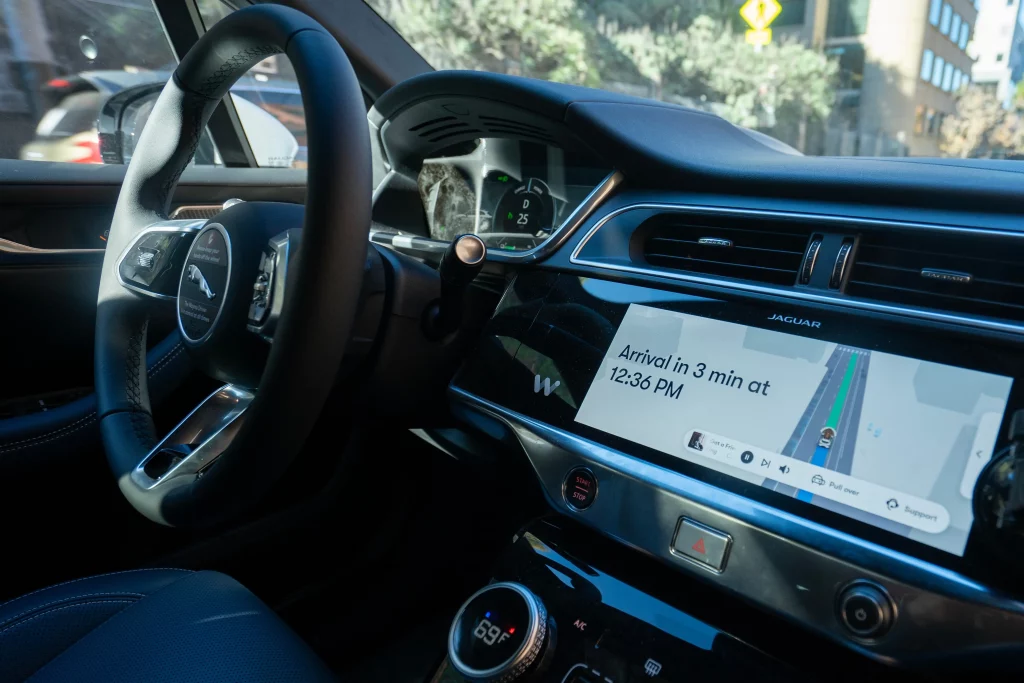

The humanoids get the headlines, but the money is moving elsewhere, and almost every form factor leans on a human and a network to do its job.
Physical AI is the loudest category in technology right now, and the least evenly commercialised. Waymo is completing around 500,000 paid driverless rides a week. Humanoid makers shipped more than 22,000 units in the first half of 2026, according to Counterpoint Research, most of them for entertainment, research and data collection rather than production work. And a $20,000 home humanoid still relies, for anything difficult, on a person in a headset somewhere else, watching through its cameras.
Those three facts look unrelated. They aren’t. Each shows how far a machine can go on its own, and each depends on a connection to a human, to a fleet, or to the data that makes the next version better.
Five form factors in physical AI
Physical AI is a broad label. It covers any machine that perceives the real world, decides what to do with AI and acts on it physically. Today that takes five main forms, and they differ sharply in where they operate, who they serve and how much they depend on a network.
Road vehicles
Robotaxis and driverless trucks are the most visible form factor. They operate in public, at speed and in mixed traffic, which makes them the hardest to certify and the most reliant on remote oversight. Waymo, Baidu’s Apollo Go, WeRide and Pony.ai run driverless passenger fleets, while Aurora runs driverless freight on US highways.
Aerial robots
Delivery drones carry small parcels, food and medical supplies over short distances and skip road congestion entirely. Zipline and Wing are the best-known operators. Drones typically fly under regulator approval and are supervised from a remote operations centre, so the link back to that centre is part of the safety case.
Small wheeled robots
Two very different jobs share this category. Sidewalk couriers, such as those from Serve Robotics and Starship, bring takeaway meals and groceries over the last few hundred metres, out in the public realm. Warehouse mobile robots move shelves, totes and pallets inside fulfilment centres. The controlled indoor setting is a big reason they scaled first, and Amazon alone now runs more than a million.
Humanoids and legged machines
These are built to work in spaces designed for people, with hands, legs and a body that fit doorways, stairs and shelving. Agility’s Digit moves totes in warehouses, 1X’s NEO is aimed at the home, and Chinese makers such as AgiBot and Unitree account for most of the units shipped. This is the form factor with the biggest ambition and the widest gap between demo and daily work.
Arms and mobile manipulators
Industrial arms have worked in factories for decades, so the fixed arm is the most mature machine on the list. What’s new is the AI: arms that learn to pick unfamiliar items, and arms mounted on mobile bases that move between tasks. These are the machines turning narrow automation into flexible automation.
Three stages of commercial reality
Sorted by what’s actually earning revenue rather than by ambition:
Earning at scale
Robotaxis lead. Waymo’s weekly paid rides have grown roughly tenfold since May 2024, to about 500,000, and Baidu’s Apollo Go completed around a million fully driverless rides in the second quarter, with more than 23 million cumulative rides. Warehouse robots are the quiet giant: Amazon passed a million of them in mid-2025. Delivery drones have reached real volume too, with Zipline passing 2.5 million deliveries by July 2026.
Commercial and ramping
Driverless trucking is the clearest example. Aurora’s trucks had completed nearly 440,000 driverless miles by the end of June, and the company says it is fully allocated to end the year with 200 driverless trucks in operation. Sidewalk delivery robots sit here too, working best on campuses and in well-planned suburbs.
Early and unproven at scale
Humanoids. Agility’s Digit has moved more than 100,000 totes for GXO under a robots-as-a-service contract that began in June 2024, and Toyota Canada signed its own commercial agreement in February. Counterpoint counts more than 22,000 humanoid shipments in the first half of 2026, up nearly 300% year on year, and expects more than 50,000 for the full year. But more than 60% of first-half units went to entertainment, performance and research or data-production uses, while manufacturing took 13% and warehousing and logistics 5%. Five Chinese vendors, led by AgiBot and Unitree, shipped 86% of the total. Home humanoids are further back still.
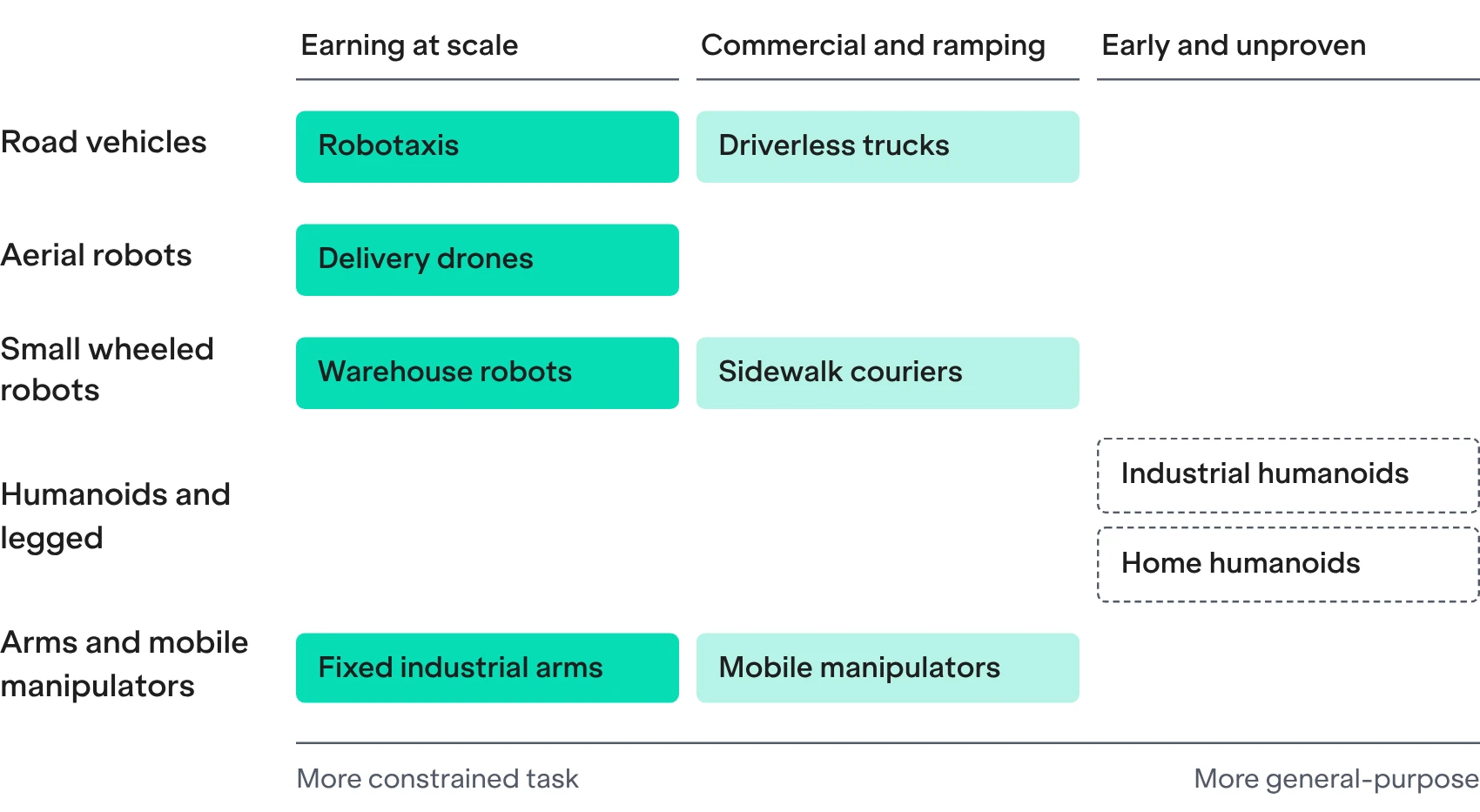

The pattern. The form factors earning revenue today aren’t the most general. They’re the most constrained. A road with lane markings, a warehouse aisle and a delivery route all shrink the problem. Commercial traction follows constraint, not capability.
The human is still in the loop
Every form factor that has reached the real world has a human layer behind it, and the humanoid makers are the most open about it. 1X sells its NEO home robot with an “Expert Mode”, where a remote 1X operator can take over, with the owner’s approval, for tasks the robot can’t yet handle. The company says plainly that those sessions are how the product improves. Robotaxi fleets run remote assistance centres. Trucks and drones run supervision desks.
This isn’t a flaw in the technology. It’s the architecture, and it creates five jobs that only a network can do:
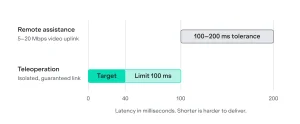
- Remote assistance: the machine hits something ambiguous and asks for help. A human reviews live video and advises. This needs reliable uplink and moderate latency.
- Remote teleoperation: a human takes direct control, usually at low speed or for short tasks. Latency becomes a safety parameter, with a target round trip well under 100 milliseconds.
- The data flywheel: every intervention, near miss and unusual scene is training data. The robot only improves if that data reaches the model, and the improved model reaches the fleet.
- Edge-case learning: one robot meets something it has never seen, and every robot in the fleet should know how to handle it by morning.
- Updates and oversight: model releases, map changes, safety telemetry and compliance reporting all travel the same link.
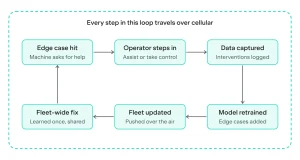
Why it matters. A dropped connection isn’t an inconvenience in physical AI. For a moving machine it means a stopped vehicle, a stalled delivery or a lost training session.
Which form factors depend on cellular?
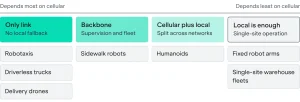
Not all physical AI needs a cellular network, and it’s worth saying so. The dependency runs on a scale:
- Cellular is the only link: robotaxis, driverless trucks and delivery drones. They cover wide areas, cross operator boundaries and have no local network to fall back on.
- Cellular is the backbone: sidewalk robots. They work in shorter, denser routes but still depend on the mobile network for supervision and fleet management.
- Cellular plus local networks: humanoids. Inside a factory they can use the site’s own network. But the operator pool, the training pipeline and the fleet management layer rarely sit in the same building, or the same country.
- A local network is usually enough: robot arms and warehouse fleets on a single site, running on private Wi-Fi or on-site 5G.
The cross-border question. A humanoid in a customer’s home streaming video to an operator on another continent raises an immediate question about where that data may travel and where it may be stored. These are the data residency questions robotaxi fleets already face, now arriving in the living room.
Across the machines that do depend on cellular, the requirements converge:
- Automotive-grade SIM hardware that survives years of heat, vibration and field conditions
- Multi-network coverage, with the device moving to the strongest network automatically
- Remote SIM provisioning for fleets of thousands, so nobody swaps cards by hand
- Contractual uptime, not best-effort targets
What changes if you act now
Connectivity is a design-time decision in physical AI. The hardware, the SIM approach and the network strategy get locked in long before a fleet ships, and retrofitting them across thousands of machines in a dozen markets costs far more than choosing well the first time. The teams scaling fastest treat the network as part of the product, not an afterthought.
At Cubic3, our work in automotive-grade IoT connectivity covers exactly this ground: multi-network global coverage, QoS prioritisation, data residency and eUICC-based fleet provisioning. We’re extending that into physical AI, starting with the form factors where connectivity decides whether the machine can work at all.
Frequently asked questions
What is physical AI?
Physical AI is any machine that perceives the real world, decides what to do with AI and acts on it physically. Today it takes five main forms: road vehicles, aerial robots, small wheeled robots, humanoids and legged machines, and arms and mobile manipulators.
Which physical AI machines make money today?
Robotaxis, warehouse robots and delivery drones already earn revenue at scale. Waymo completes around 500,000 paid rides a week and Zipline passed 2.5 million deliveries by July 2026. Humanoids are still early, with 13% of first-half 2026 shipments going into manufacturing, according to Counterpoint Research.
Which physical AI machines depend on cellular connectivity?
Robotaxis, driverless trucks and delivery drones use cellular as their only link because they cover wide areas with no local network to fall back on. Sidewalk robots rely on it as their backbone and humanoids mix it with local networks. Robot arms and single-site warehouse fleets can usually run on private Wi-Fi or on-site 5G.
What latency does robot teleoperation need?
When a human takes direct control of a robot, the round trip needs to stay under 100 milliseconds, and the target is under 40. Remote assistance, where an operator watches live video and advises, can tolerate 100 to 200 milliseconds but needs a 5 to 20 Mbps video uplink.
Why do robots still need remote human operators?
When a robot meets something it can’t handle, a remote operator reviews its video or takes control, and that intervention becomes training data for the whole fleet. 1X sells its NEO home robot with an Expert Mode that lets a remote 1X operator take over with the owner’s approval.
What connectivity does a robot or robotaxi fleet need?
A fleet that depends on cellular needs automotive-grade SIM hardware, multi-network coverage and remote SIM provisioning backed by contractual uptime. Cubic3 provides automotive-grade IoT connectivity with multi-network global coverage, QoS prioritisation, data residency and eUICC-based fleet provisioning.