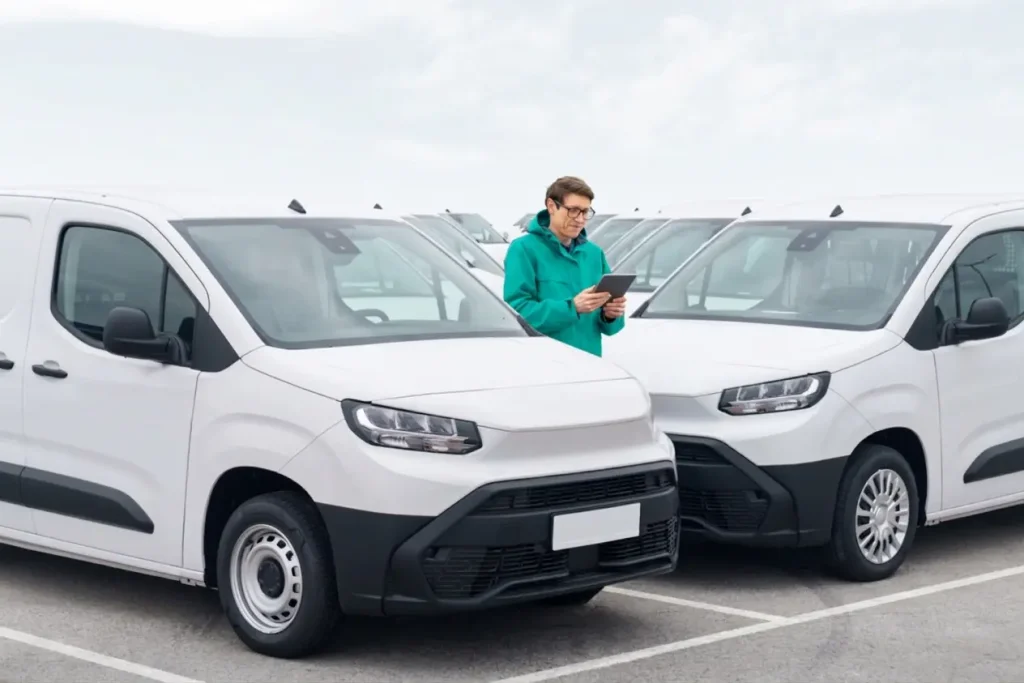
Fleet payment platforms such as FleetWallet3 reduce manual payment handling by recording each fuel payment as the driver makes it, checking it against the vehicle’s own data and sending a coded record to finance. For delivery fleet managers, that removes most of the receipt chasing and line-by-line matching that sits between a fill-up and a closed month.
Volume is what makes this matter in delivery. Take a depot running 60 vans. If each van fills up twice a week, that is around 520 fuel transactions a month, spread across drivers, shifts, vehicles and cost centres. Each one has to be paid for, evidenced, checked and coded before the books close.
Why manual payment handling slows delivery fleets down
Delivery fleets pay for fuel differently from long-haul operators. Routes are short, fills are small and frequent, and vans change hands between shifts. Cards get passed between drivers and agency staff, and receipts end up in door pockets, depot trays and finance inboxes.
Each fill-up creates several records: the card transaction, the paper receipt, a line on the supplier statement and later a line on the invoice. Someone has to bring those together. In many delivery businesses that person is a depot manager or a member of the finance team, doing it on top of their main job.
Fleets moving to electric vans add another layer. Charging is often paid for with separate cards or apps, each with its own statement to reconcile.
The vehicle data is already there
A growing share of commercial vehicles already report where they are and how far they have travelled. Berg Insight counted 18.1 million fleet management systems in active use in Europe at the end of 2024 and expects 30.5 million by 2029, by which point they will be fitted to 42.8% of commercial vehicles and company cars.
Payment data and vehicle data usually sit in different systems, though. They only meet when someone exports both and lines them up in a spreadsheet.
Late checks cost more than the admin
When fuel spend is checked at month-end, problems surface weeks after the money has gone. A fill bigger than the van’s tank, or a payment at a station well off the day’s route, is easy to question on the day and hard to recover a month later.
Fleet payment reconciliation, step by step
Below is how the manual process usually runs, and what changes at each stage with FleetWallet3. In outline, the automated version works like this:
- The driver pays for fuel from the vehicle at the pump.
- FleetWallet3 checks the payment against that vehicle’s data.
- A coded record goes to your finance or TMS.
1. Paying at the pump
With a fuel card, the driver hands over the card, enters a PIN and takes a receipt. Nothing ties the payment to a specific van, so a card shared between drivers or used for the wrong vehicle looks the same as any other transaction.
With FleetWallet3, the driver pays from the vehicle, so each payment is linked to that van from the start. FleetWallet3 is accepted at more than 5,300 fuel retailers in 12 European countries through Cubic3’s partnership with CarPay-Diem, and works alongside existing fuel cards without extra hardware in the vehicle.
2. Collecting receipts
Drivers keep paper receipts and hand them in at the end of a shift or week. Some fade, some get lost, and depot managers spend time chasing the rest.
FleetWallet3 creates a digital record at the moment of payment, so there is nothing to collect.
3. Checking each transaction
Checking a fuel card statement means comparing each line with mileage, location and tank size held in another system. Most fleets only have time to spot-check.
FleetWallet3 checks each payment against the vehicle’s telematics data as it happens, so any payment that doesn’t match is flagged the same day.
4. Coding and approval
Every transaction has to be assigned to a driver, a vehicle, a depot and a cost centre, then approved. With paper receipts this is typed in by hand, and approvals tend to happen by email.
Each FleetWallet3 payment already carries the vehicle and driver it belongs to, so the coding is done before the record reaches finance.
5. Reconciliation and VAT
At month-end, finance matches supplier invoices against statements and receipts. To reclaim VAT on road fuel, HMRC requires a valid VAT invoice, as set out in VAT Notice 700/64 on motoring expenses. A missing or unreadable receipt can mean VAT that cannot be reclaimed.
Fleets that buy fuel or services across EU borders also have a deadline to plan for. Under the EU’s VAT in the Digital Age (ViDA) package, adopted on 11 March 2025, structured e-invoicing and digital reporting become mandatory for cross-border business-to-business transactions from 1 July 2030. Paper and PDF records will not meet that standard.
FleetWallet3 cuts the time spent on fleet payment reconciliation by [METRIC: approved source required] because each payment is matched to its vehicle when it is made. [CLAIM: confirm how VAT invoices are produced and in what format.]
6. Reporting
Most fleet spend reports are built by exporting data from fuel card portals, telematics and accounts, then joining it in a spreadsheet. By the time anyone reads the report, it is out of date.
FleetWallet3 brings transaction data from several sources into one view that updates as payments happen.
What changes for a multi-depot delivery operation
Depot managers stop collecting and checking receipts and deal only with the payments flagged as unusual. Finance starts month-end with records that are already coded and matched to vehicles.
WEBINAR
How to Stop Fleet Spend Leakage & Regain Cost Control
Fleet spend leakage is eroding your margins across freight and logistics operations. Learn how to regain control of your fleet spend with this free on-demand webinar now.
For fleet managers who already run telematics, FleetWallet3 connects each payment to data they already hold. In the 60-van example, that means 520 transactions a month reaching finance already checked and coded.
Frequently asked questions
How do fleet payment platforms reduce manual reconciliation?
They record each fuel payment digitally at the pump and link it to the vehicle that made it, so there are no paper receipts to collect and no statement lines to match by hand. FleetWallet3 does this from the vehicle at more than 5,300 fuel retailers in 12 European countries.
Do we still need fuel receipts to reclaim VAT?
HMRC requires a valid VAT invoice to reclaim VAT on road fuel, under VAT Notice 700/64.
Will a fleet payment platform work with our current fuel cards and telematics?
It depends on the platform, so check before you switch. FleetWallet3 works alongside existing fuel cards and telematics systems and needs no extra hardware fitted to the vehicle.
Where can drivers pay using in-vehicle fleet payments?
Coverage depends on the payment network behind the platform. FleetWallet3 is accepted at more than 5,300 fuel retailers across 12 European countries, including Germany, France, Spain, Italy and the Netherlands, through CarPay-Diem.
When does e-invoicing become mandatory for fleets operating in the EU?
Under the EU’s VAT in the Digital Age package, structured e-invoicing and digital reporting become mandatory for cross-border business-to-business transactions from 1 July 2030. FleetWallet3 creates a digital record of each fuel payment at the moment it is made.
Month-end without the receipt pile
See how FleetWallet3 checks and codes every fill-up across your depots