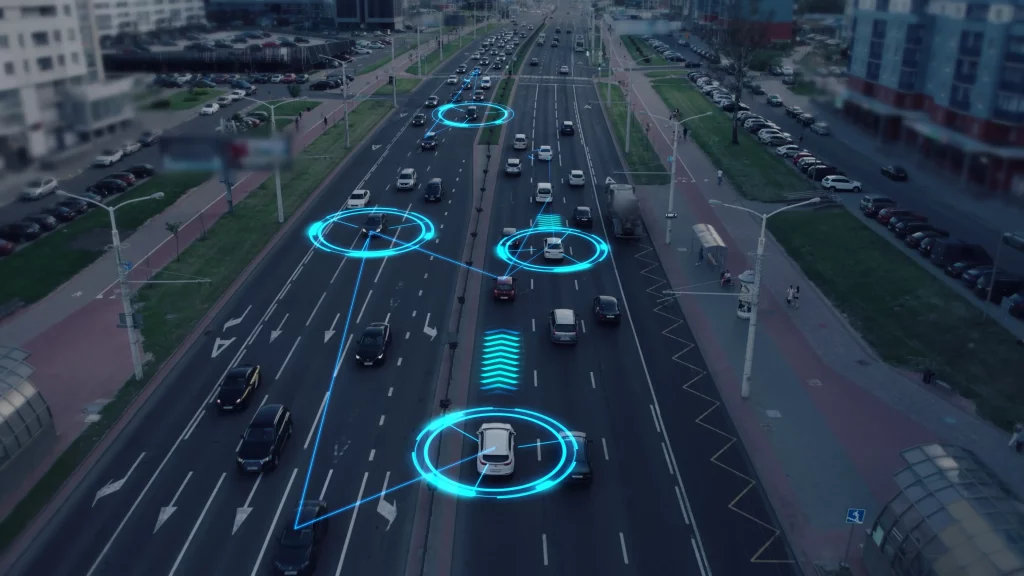
Today’s vehicles need constant connectivity if they are to deliver highly dependent services like navigation, infotainment, over-the-air (OTA) updates and safety features. Behind the scenes, it’s a small but critical piece of technology that’s helping make this possible: the eSIM.
What is an eSIM?
An eSIM, or embedded SIM, is a chip built directly into a vehicle’s telematics control unit (TCU). Unlike traditional SIM cards, it’s managed entirely digitally, allowing automakers and service providers to remotely connect vehicles to mobile networks and update subscription profiles without physically accessing the car.
This process is known as Remote SIM Provisioning (RSP) and is governed by standards developed by the GSMA. The most relevant specifications for the connected car industry are SGP.02, designed for machine-to-machine (M2M) deployments, and SGP.32, a more recent standard intended for IoT devices, including connected cars.
While SGP.02 remains the primary standard used in the industry today, automakers are increasingly looking to SGP.32 Remote SIM Provisioning for its enhanced flexibility and streamlined integration — positioning it as a key enabler for the future of automotive eSIM connectivity.
The limitations of traditional SIMs
Before eSIM for connected vehicles, automakers had to install physical SIM cards in each car — just like in mobile phones. As connected car services became more advanced, this approach created significant operational challenges. Each vehicle needed a market-specific SIM, forcing manufacturers to predetermine its destination, complicating logistics and limiting flexibility.
Roaming restrictions and regulatory requirements added even more complexity, increasing costs and reducing agility. For drivers and passengers, this could mean unreliable, inconsistent or expensive connected experiences — especially when crossing borders or travelling through areas with weak network coverage.
eSIM technology, combined with Remote SIM Provisioning, helps eliminate these issues by enabling dynamic, remote network management. This makes vehicle connectivity more scalable, cost-efficient and globally consistent — laying a stronger foundation for connected cars eSIM strategies

SGP.32 Remote SIM Provisioning: a new era for automotive eSIM connectivity
The latest eSIM industry standard — SGP.32 — is a breakthrough for automakers. It provides them with greater freedom and flexibility by allowing over-the-air switching of network profiles without driver involvement or being locked into a single mobile operator.
In contrast to the earlier eSIM standard SGP.02 (M2M), the. new SGP.32 (IoT) standard, introduces a more open, cloud-native architecture. This reduces vendor lock-in and allows for better compliance with regional roaming restrictions and data sovereignty laws.
SGP.32 also supports 5G -enabled services, making it ideal for next-generation applications like real-time telematics, in-car Wi-Fi, and even autonomous driving. From a manufacturing perspective, the ability to install a single eSIM configuration in all vehicles, regardless of their destination market, means logistics and fleet deployment are simplified.
This shift makes vehicle connectivity eSIM management significantly more efficient across global markets.
The long-term value for automakers
Connected cars eSIM capabilities unlock long-term opportunities. With automotive eSIM connectivity, automakers can offer advanced services like low-latency communication, remote diagnostics and continuous OTA updates — all supported by evolving 5G infrastructure
In addition, by removing dependency on specific mobile operators, eSIM and SGP.32 future-proof vehicles against network changes and simplify service delivery across both telematics and consumer applications. This gives OEM greater control, reduces operational overheads and opens up new opportunities for service monetisation and innovation.
Additionally, by embedding a standardised eSIM setup at the point of production, manufacturers reduce SKU complexity, lower costs and improve supply chain efficiency.
With SGP.32 vehicles are also better able to support evolving services such as 5G network slicing, real-time data streaming and software-based vehicle updates. This helps automakers stay competitive throughout the vehicle’s lifecycle.
Better connectivity for car users
eSIM for connected vehicles delivers a more seamless experience for drivers and passengers. By combining SGP.32 remote SIM provisioning with an advanced connectivity management platform, automakers can ensure reliable and seamless connectivity. This ensures uninterrupted access to features like navigation, entertainment and emergency services — no matter where the car travels.
Unlike earlier standards, drivers won’t need to worry about managing network connections. With SGP.32, everything happens in the background — from carrier profile updates to network switching — making the entire experience hassle-free and globally consistent.
Greater support of consumer and telematics applications also means lower costs and broader access to premium features, even in emerging or fragmented markets.
The value for software-defined vehicles
SGP.32 strengthens the connectivity foundation for software-defined vehicles (SDVs). It supports remote provisioning, multi-operator management and real-time adaptability — all essential for the connected cars of the future.
While SGP.32 is expected to become the universal standard for eSIM provisioning in connected cars, the timelines for testing, certification and availability of eSIM SGP.32 will depend on regional regulatory approvals, mobile network readiness and OEMs rollout strategies.
There are challenges OEMs need to navigate if they want to adopt the standard successfully, those automakers that plan for them today will be ahead of the curve.
With SGP.32 connected vehicle infrastructure will become more agile, efficient and future-ready — driving the evolution of SDVs and enabling a full lifecycle of remote service management.
The future powered by Cubic3
The arrival of SGP.32 marks a significant turning point for automotive eSIM connectivity. However, adopting this standard can be complex for automakers, from managing multiple carrier relationships to integrating new processes into existing back-end systems and managing changing regulatory and compliance frameworks.
Cubic3 Cloud simplifies this. Our platform enables automakers to harness the eSIM SGP.32 standard quickly and effectively. We make it easier for automakers to manage both legacy and next-generation eSIM technology, switch carriers based on real-time needs and stay compliant globally — all through a single interface.
By removing complexity and giving OEMs full control over their connectivity strategy, we help automakers deliver seamless, reliable connected vehicle services.
Discover more eSIM for connected vehicles and how to harness SGP.32 remote SIM provisioning in our new eBook: ‘SGP.32: How eSIM is Changing the Game for Automakers’