

By Ric Vicari, SVP VAS GTM at Cubic3, and Andy Hart, CEO, SBD Automotive
For a decade, the business case for the connected vehicle rested on new digital services and recurring software revenue. Measured against that expectation, the results look thin. SBD Automotive estimates that direct subscription revenue sits well below 1% of total revenues for most OEMs, rising to around 1.5 to 2% at General Motors and closer to 5% at Tesla. In addition, software-defined vehicles enabled by connectivity were expected to drastically reduce recall costs. However, evidence suggests that software-related recalls have been on the rise since 2019.
The conclusion many people draw from that is that connectivity has underdelivered. It is the wrong conclusion, because it measures one narrow revenue line and ignores everything else the investment produced. The returns are real. They are distributed, and most of them never appear as revenue at all. They show up as engineering productivity, faster validation cycles, earlier defect detection, lower warranty exposure, better retention and a stronger cybersecurity posture.
That distribution creates a second problem, which is what this article is about. When the value lands in five different budgets, and the cost lands on one line, the investment case gets harder to defend each year rather than easier. The teams closest to that value usually have very little influence over the infrastructure decisions that determine what is possible in the first place.
Where the value actually sits
SBD groups connected-vehicle value into five pools. Two are direct. Consumer digital revenue covers connectivity, safety, security, navigation, entertainment and commerce. Enterprise and data revenue covers fleet services, vehicle data and APIs, insurance and risk data, mobility and infrastructure data, and technology licensing.
Three are indirect, and they are where most of the money has quietly gone. Vehicle sales and retention cover acquisition, purchase conversion, upsell, next-vehicle migration and residual value. Aftersales and ancillary revenue covers service retention, predictive maintenance, parts, insurance, finance and used-vehicle activity. Cost and operational efficiency covers warranty and recall reduction, remote diagnostics, service and repair efficiency, quality management, product and R&D optimisation, hardware and feature optimisation, and supply-chain efficiency.
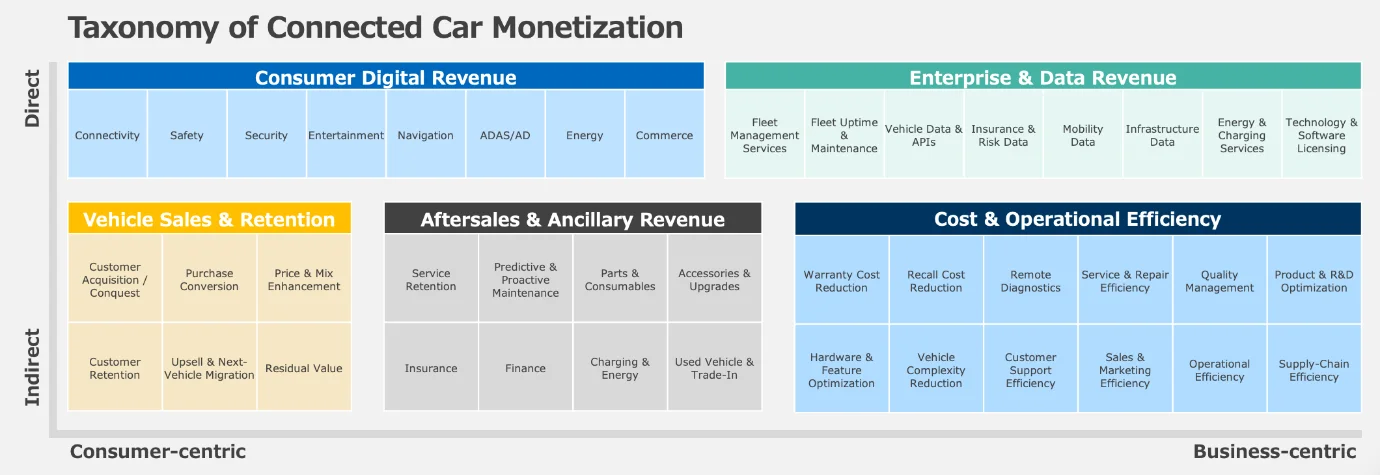
Set out that way, the subscription number stops looking like a verdict on connectivity and starts looking like what it is: one column out of five.
The cheapest returns are the internal ones
The clearest evidence sits in the cost and efficiency pool, because the savings are measurable and they arrive quickly.
Aptiv published a case study in 2020 describing a US full-size pickup launch. The OEM’s existing pre-production validation process would only have surfaced a warranty problem severe enough to trip a malfunction indicator. The team fitted 72 test vehicles with edge computing hardware sampling at roughly fifty times the rate of conventional telematics. After 3.85 million test miles, and after the trucks had passed the manufacturer’s most stringent testing, the data showed misfires in some vehicles. The fault never tripped the check engine light. Engineers found the cause, built a calibration fix and flashed the 2,000 trucks already waiting to ship, and the launch went ahead on schedule. Aptiv put the avoided warranty cost at $50 million, a twentyfold return on what the OEM had spent on the solution.
The signal was in the vehicle the whole time. What changed was the decision to collect it at a resolution that made it visible, and that decision came late, after bringing in a supplier and fitting hardware the production platform did not have.
The pattern repeats at a less dramatic scale. In SBD interviews with automotive data and diagnostics specialists, warranty reduction came up consistently as one of the strongest internal business cases for connected vehicle data. One anonymised OEM pilot reported a reduction in warranty costs of around 7% in its first year, using vehicle data streams it already had, combined with analytics to identify high-cost issues earlier.
That second example matters more than the first. It required no heroics and no emergency programme. It required existing data and the ability to act on it.
Software recalls are rising while OTA capability lags
Automotive OEMs have long positioned connectivity and the software-defined vehicle (SDV) as a way to cut recall costs. With over-the-air (OTA) updates, a defect that once required a dealer visit can be fixed remotely, and Harman Automotive puts the cost of an OTA reflash at about $66.50 per vehicle, against an average recall cost of roughly $500.
The growing volume and complexity of vehicle code have pushed software-related recalls in the opposite direction. Software recalls reported to the National Highway Traffic Safety Administration (NHTSA) have set a record in each successive year since 2019, and 2025 was on course for a sixth, with 166 issued by late November. The rate of increase is steep: software-related recalls rose by around 80% in 2024, from 112 cases in 2023 to 202. Because many OEMs still lack robust OTA capability, much of that remediation continues to happen at dealerships, at a cost of more than $2.5 billion to Ford and about $1.8 billion to Stellantis across 2024 and 2025. The promised savings have so far gone to the small number of automakers that can deploy fixes remotely at scale.
Vehicle data is becoming a product, not an API
The same shift is visible on the revenue side, where OEM data businesses are getting more commercially sophisticated. Rather than charging a single access fee, more advanced programmes price by data type, access frequency, service level, and customer scale. SBD has documented BMW pricing per key and per event, with volume discounts and monthly caps; Ford offers tiered API packages based partly on polling frequency; and Mercedes-Benz builds use-case-led products with different service levels and bespoke pricing for more complex requirements.
Aftersales is moving the same way. BMW’s Proactive Care uses vehicle data and AI to identify potential service needs and contact customers before they notice a problem, then guides them through scheduling, personalised recommendations, and payment. SBD has also studied a connected aftersales programme extended across most of an OEM’s European distributors, with connected vehicle data feeding CRM, the call centre, roadside assistance and dealer service processes. The value there is not the data. It is the service revenue, the parts and the retention that the data made possible.
None of this shows up in a subscription line either.
The funding problem
So connected infrastructure creates value, and the evidence for that is now reasonably clear. The harder question is whether organisations have the mechanisms to identify that value, attribute it and reinvest it.
Often they do not. Cybersecurity gains from better vehicle intelligence. Engineering gains from faster validation. Quality gains from earlier defect detection. Aftersales gains from prognostic leads. Customers gain from better services. Meanwhile, the spend lands on one line in one budget as a technology cost. Distributing value across five owners while keeping the investment case with one of them is a well-established way to lose funding for something strategically important.
Read SBD’s taxonomy again with that in mind, and it stops being a map of revenue opportunities. It becomes a map of who benefits, which any serious attribution model must establish first.
Who is in the room when the platform is specified?
A platform is valuable because it lowers the cost of building whatever comes next. Every capability built on it should be quicker to develop and deploy than the one before it. That only holds if the platform enables the capabilities that actually matter, which raises the question this article is really about.
Do the teams closest to value creation have enough influence over the infrastructure decisions that determine what is possible?
Usually, they do not. Engineers exploring predictive quality, cybersecurity teams tracking emerging threats, product teams building new customer experiences and operations teams hunting efficiency all know which signals would unlock something. But the onboard hardware, software architecture, connectivity, and data collection strategy were specified years earlier, based on assumptions about future needs that have since shifted. The result is familiar. Heavy investment in connected capability, and very little flexibility to use it.
The pickup launch is that gap in miniature. The signal the engineers needed existed in the vehicle. The platform could not surface it at the resolution required, so the capability had to be bolted on under time pressure, ten months out from launch. It worked, and it saved a great deal of money. It is not a repeatable operating model.
Flexibility matters more than volume here. More signals don’t produce more insight, and more storage doesn’t produce better decisions. What matters is how quickly a team can test a use case, collect the signal it needs and scale the ones that prove out. Today’s use cases will never justify some platform investment. It buys option value, and it makes future work faster and cheaper before anyone knows what that work will be.
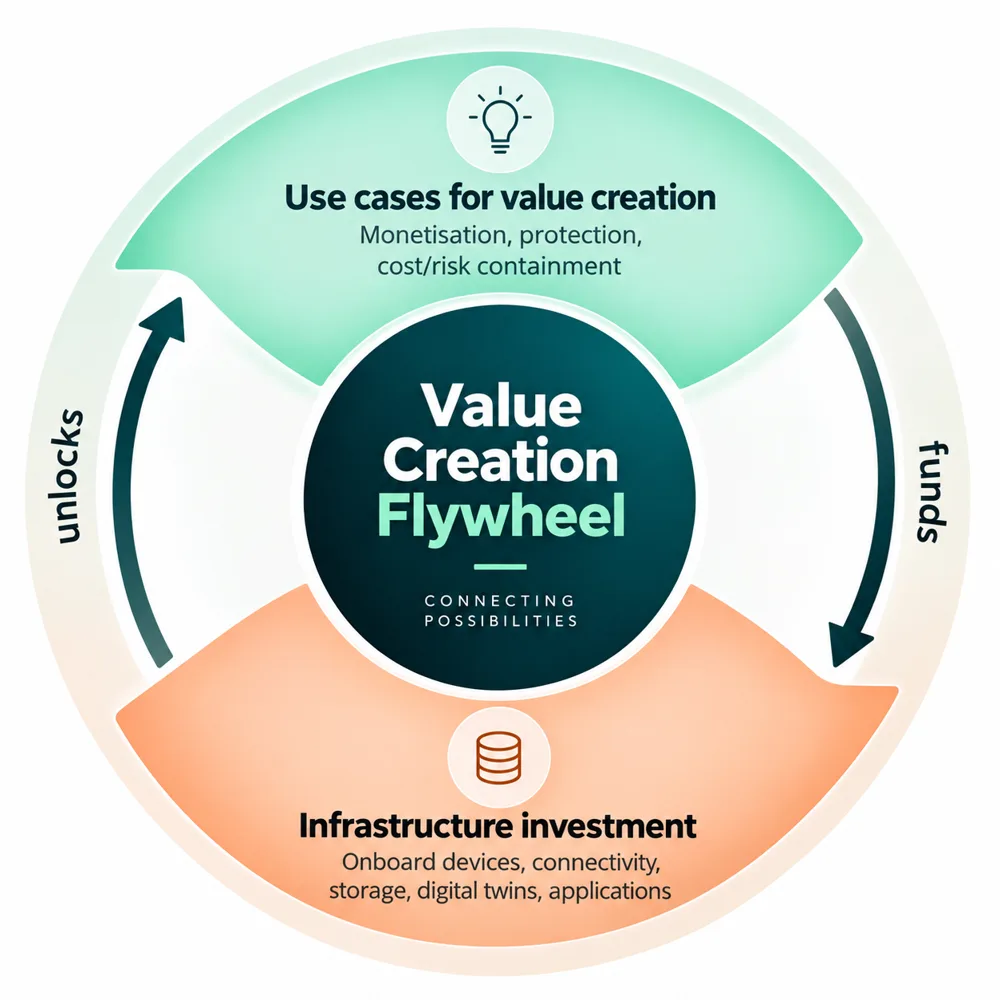
AI raises the stakes.
AI changes the economics of that loop. Until recently, organisations produced operational data far faster than they could interpret it, and human expertise was the constraint. That constraint is lifting. AI lowers the cost of analysing complex systems and shortens the time between a signal appearing and someone acting on it.
Which makes alignment more urgent, not less. An AI agent is only as good as the data, the architecture and the operational context available to it, and all three are set by infrastructure decisions taken long before the agent exists. AI sits inside the platform as its intelligence layer, and it inherits every limitation built into the foundations beneath it.
Turning the flywheel
Four things make the loop turn faster.
- Put use-case owners in the room when infrastructure is specified, not after. The cybersecurity, quality and engineering teams know which signals they will want two years out.
- Attribute value where it lands. If warranty savings sit in one budget and the platform cost sits in another, the platform will always look expensive.
- Budget for option value explicitly and accept that some capability is bought before its use case exists.
- Measure how long it takes to go from “we want this signal” to “we have this signal”. That number tells you more about your platform than any capability list.
None of this argues that consumer subscriptions are finished. They remain an important part of most OEM strategies, and there is room for them to grow. The point is that the business case no longer rests on them alone. It comes from combining direct digital revenue with B2B and data revenue, aftersales and retention benefits, and internal cost savings.
Connecting more assets is the easy part. The organisations that pull ahead will be the ones whose infrastructure decisions are shaped by the people closest to the value, so that every connected asset makes the next unit of value cheaper to find.