Over the past decade, the pursuit of self-driving cars has captured the public imagination and inspired unprecedented collaboration between carmakers and tech innovators. But how close are we to seeing autonomous vehicles (AVs) on our roads? While predictions suggest that one in 10 vehicles will be fully automated globally by 2030, many challenges remain. In reality, developing AVs requires many pieces of a very complicated puzzle to fall into place before they become a normal sight on the roads.
Despite ambitious real-world testing and exciting vehicle projects continuing to build hype around AVs, many automakers now acknowledge that developing the technology is more complex than they originally thought. However, optimism for AV technology (enabled by 5G and AI) is growing, thanks to advancements in partially autonomous cars offering a more realistic vision of what the next decade may look like. With the potential to transform everything from our mobility behaviours to how future smart cities are designed; what factors will play a role in delivering a self-driving future?
Understanding vehicle autonomy
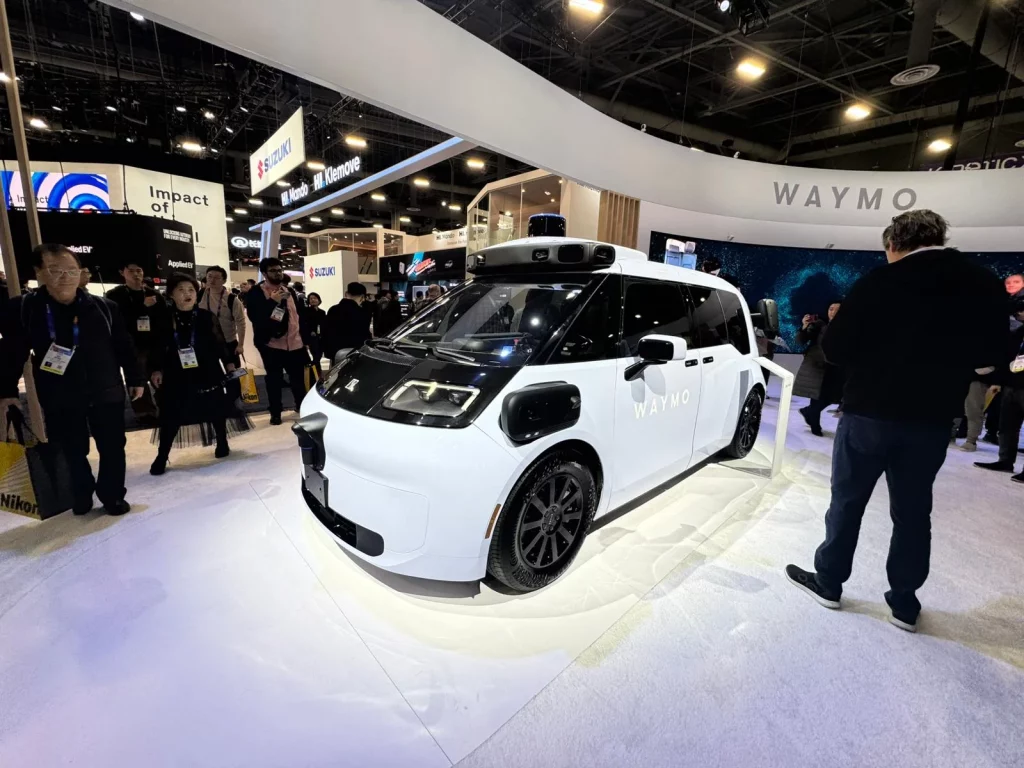
The Society of Automotive Engineers (SAE) has created a framework of standards for measuring the capabilities of AV capabilities, ranging from Level 0 (fully human-controlled) to Level 5 (full autonomous). For example, Tesla’s A technology is considered Level 2, where the vehicle can manage functions like steering and acceleration but still requires a driver to be ready to take over. On the other hand, Google’s self-driving car project Waymo operates at Level 4, with driverless cars already shuttling passengers around Phoenix. On the other hand, Google’s self-driving car project Waymo operates at Level 4, with driverless cars already shuttling passengers around Phoenix.
At the University of Michigan’s Mcity Test Facility, carmakers like Ford are testing the limits of autonomous technologies in a controlled, fake city. In this controlled test environment, roughly the size of 24 football fields, researchers are gaining valuable insights on how connected and autonomous vehicles can operate in realistic conditions.
Technology for safer roads
One of the main reasons for the development of autonomous vehicles is the promise of a safer journey for all. The U.S. National Highway Traffic Safety Administration reports 9 out of 10 crashes are due to human error. If AV technology can catch up with the promise, it has the potential to significantly reduce traffic accidents by relying on a system that can see and respond to road conditions better than the best human driver.
What’s clear is that data will be key to unlock the potential of AVs. Today’s connected cars generate up to 25 GB of data per hour but in the future, autonomous vehicles are likely to generate more than 300 TB of data per year. This data will be crucial to the continuing evolution of safety technologies to navigate roads with little or no human input.
Many modern vehicles are already equipped with advanced driver-assistance systems (ADAS) that use sensors like radar and lidar to detect obstacles. These systems are becoming more sophisticated with each new generation of vehicles. The introduction of 5G technologies will further enable Artificial Intelligence (AI) and analytical capabilities in self-driving cars, making AV technology more reliable, effective, and successful.
Industry collaboration and policy matters
Creating the car of the future will require intense long-term collaboration between tech innovators, automakers, telecoms, government agencies and others. As the saying goes, competition drives innovation, though the challenges involved are too complex and costly for any one party to tackle alone. Exciting progress is being made, particularly in China, where private and public support for autonomous vehicle technologies is strong. China’s ride-hailing service Didi, for instance, plans to roll out over one million robotaxis on its platform by 2030, while new rules around AV development are fuelling a boom in the commercialisation of autonomous cars.
However, the framework for self-driving automotive technology will depend on regulatory developments from policy makers, which is proving to be a complicated hurdle in the pursuit of making AVs mainstream and commercially viable. As responsibility for accidents shifts away from drivers and regulations around AI grow more complex, the industry will face complicated questions that must be addressed.
Despite the obstacles, consumers are ready for driverless cars. While industry experts agree that AVs have the potential to truly transform mobility, predicting when they will become mainstream will become harder. To accelerate the future of the automotive industry over the coming decade, multi-layered challenges must be resolved by next-generation tech innovations.
Cubic3’s connected software and analytics solutions, are at the forefront of tomorrow’s landscape of connected, electric, and autonomous cars driving intelligence across the mobility sphere.
Download our eBook: How to Become a software-driven car manufacturer with an autonomous digital platform